
Be the First to Know!
Coming November 1, 2026
Join the book launch list to be notified when Ecology of New Hampshire’s 4,000-Foot Mountains becomes available.
About the Book
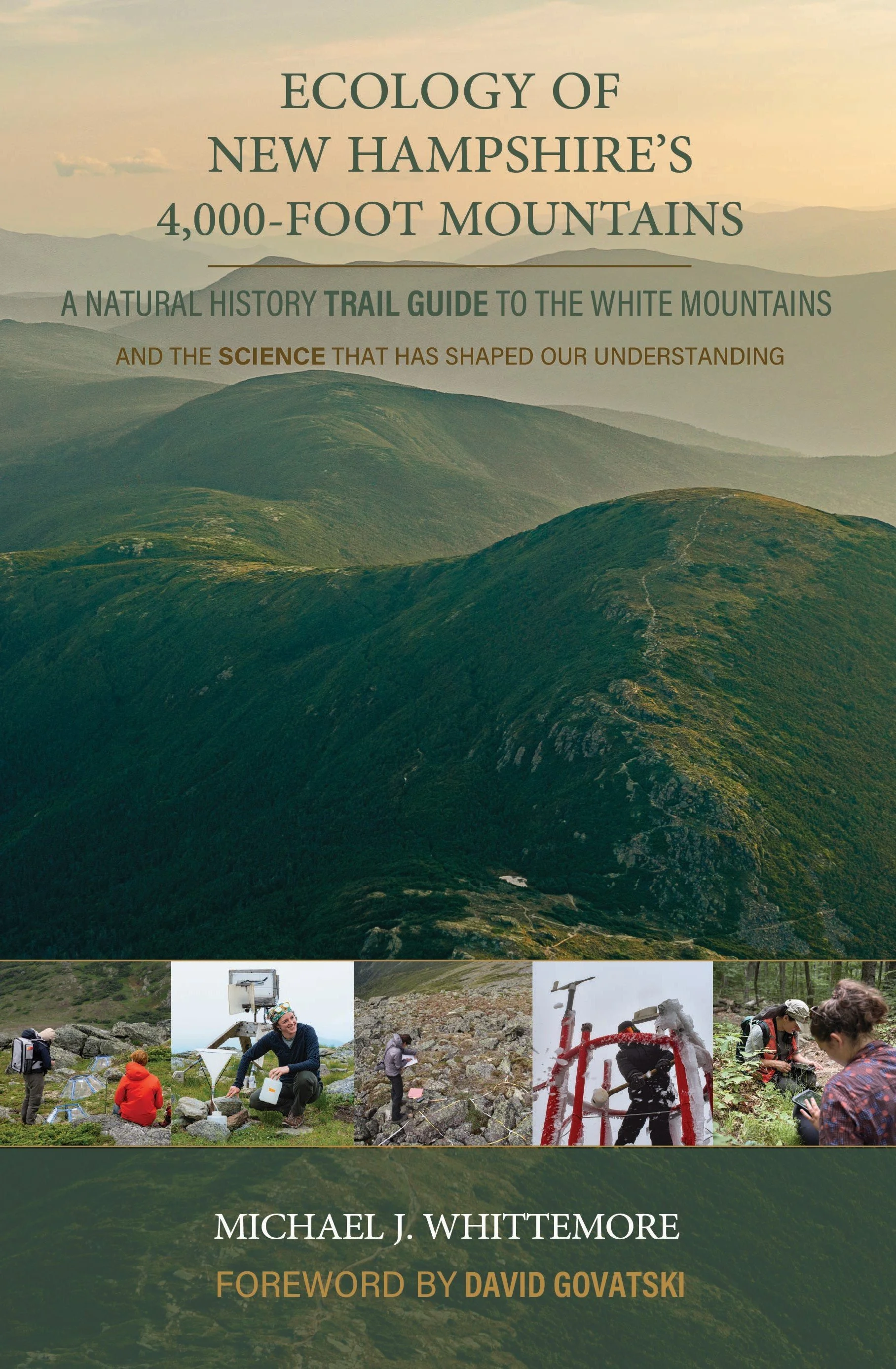
Ecology of New Hampshire’s 4,000-Foot Mountains: A Natural History Trail Guide to the White Mountains — How Science Has Shaped Our Understanding uses the trail systems of the 48 peaks as a framework for exploring the ecology and natural history of New Hampshire’s highest mountains. Blending field science with accessible interpretation, the book examines the geology, forests, alpine ecosystems, wildlife, and plant communities that shape the region. Detailed trail maps show habitat types along popular routes, while nearly 20 “Ecology in Action” sections profile long-term scientific studies in the White Mountain National Forest and connect their findings to features hikers can observe from the trail. Individual mountain profiles explore each peak’s distinctive ecology, geology, flora, fauna, and conservation significance, with species summaries informed by thousands of iNaturalist observations. Nearly 400 high-quality photographs contributed by more than 200 local and regional photographers bring the mountains, habitats, wildlife, plants, landscapes, and scientific research to life throughout the book. Written for hikers, naturalists, and conservationists, the guide encourages readers to look beyond the summit views and better understand the ecological processes that make the White Mountains such a remarkable landscape.
Foreword by David Govatski, one of New Hampshire’s most respected conservationists and naturalists.
Scientific Reviewers
Scott Bailey, PhD
Geologist and former USDA Forest Service researcher specializing in forest soils, hydrology, geology, and long-term ecosystem research in the White Mountains, including Hubbard Brook.
J. Dykstra Eusden Jr., PhD
Professor Emeritus of Earth and Climate Sciences at Bates College and White Mountains geologist. Author of The Presidential Range: Its Geologic and Tectonic History and lead coauthor of The Geology of New Hampshire’s White Mountains.
Kenneth D. Kimball, PhD
Ecologist and retired Director of Research for the Appalachian Mountain Club, with decades of research on alpine ecosystems, climate, air quality, and conservation in the White Mountains. Primary author of the Ecological Atlas of the Upper Androscoggin River Watershed.
Katie Schide, PhD
Geologist and geomorphologist whose research focuses on landslides, erosion, and mountain landscape evolution. She earned her PhD from ETH Zurich and is also a former AMC hut crew member and professional mountain ultrarunner.
Dan Sperduto
Ecologist, botanist, and founder of Sperduto Ecological Services, and former Senior Ecologist with the New Hampshire Natural Heritage Bureau and The Nature Conservancy. Coauthor of The Nature of New Hampshire and Natural Communities of New Hampshire.
Jordon C. Tourville, PhD
Staff Scientist–Terrestrial Ecology with the Appalachian Mountain Club, specializing in forest and alpine ecology, climate-driven vegetation change, phenology, and northeastern mountain ecosystems.
Steven D. Smith
White Mountains author, naturalist, photographer, and veteran AMC trail-guide editor. His books include Ponds and Lakes of the White Mountains and contributions to the White Mountain Guide and other regional trail guides.

About the Author
Michael J. Whittemore is an ecologist, botanist, conservation professional, and founder of Rewild Ecological. He has more than a decade of experience in ecological restoration, land stewardship, botanical survey work, and conservation science, with past positions at The Nature Conservancy, Woodwell Climate Research Center, Frenchman Bay Conservancy, and the Central Pine Barrens Commission. He currently serves as Communications & Engagement Manager at Ammonoosuc Conservation Trust in northern New Hampshire.
Michael holds an M.S. in Environmental Studies from Ohio University, where his graduate research focused on mapping plant communities across a 2,000-acre old-growth forest. His fieldwork has ranged from coastal restoration and rare-species monitoring to forest ecology and large-scale conservation planning. In 2026, he led a botanical inventory of The Bowl Research Natural Area in the White Mountain National Forest.
An avid hiker, Michael has completed New Hampshire’s 48 4,000-footers and the Northeast 111. His work combines field ecology, conservation, and a lifelong interest in helping people better understand the landscapes they explore.