
 Image 1 of 1

About the Book
Endorsements
“This landmark book—the first comprehensive ecology and natural history guide to New Hampshire’s 48 4,000-foot mountains—brings the landscape to life for novice hikers and seasoned peakbaggers alike. From the forces that shape the Whites to the trees, birds, plants, and geologic features encountered along their trails, Whittemore’s richly illustrated guide is an essential companion for anyone who wants to better understand these peaks.”
— Steven D. Smith
Author, The 4000-Footers of the White Mountains; co-editor, AMC White Mountain Guide; member, AMC Four Thousand Footer Committee
“Impressive is the word. Whittemore’s comprehensive guide to the ecology of the White Mountains is just that. Beginning with an overview of the geologic foundation, climatic stressors, and habitat varieties, then moving to the ecological details of the 48 4,000-footers, this is a must-have for everyone from the casual hiker to the diehard field scientist. We are lucky to have this resource as we navigate the world’s rapidly changing ecological systems.”
— J. Dykstra “Dyk” Eusden Jr., PhD
Professor Emeritus of Earth and Climate Sciences, Bates College; co-author, The Geology of New Hampshire’s White Mountains
“It’s always hard to describe what makes the Whites so special. We all have our own personal connections to this unique mountain range, but Whittemore goes deeper, revealing the natural history behind the landscape and the ecological details that make these mountains unlike anywhere else.”
— Katie Schide, PhD
Geologist, professional trail runner, and former Appalachian Mountain Club hutmaster; 2024–2025 UltraRunner of the Year
“We are in a time when mountains and alpine environments in the Northeast are facing extraordinary environmental changes and threats. The need for scientists and managers across the region to work together has never been greater. In this context, this book is both timely and valuable. It not only provides readers with detailed information on New Hampshire’s high peaks, but also puts a human face on the science being done in these remarkable mountains.”
— Jordon C. Tourville, PhD
Staff Scientist–Terrestrial Ecology, Appalachian Mountain Club; Visiting Scholar, Department of Geography, Dartmouth College
Scientific & Subject-Matter Review
The book was strengthened through review and consultation with scientists, naturalists, researchers, and White Mountains experts across geology, alpine ecology, botany, ornithology, forest science, wildlife ecology, and freshwater ecology.
Scott Bailey, PhD — Geologist and longtime Hubbard Brook scientist; forest soils, hydrology, biogeochemistry, and ecosystem research
J. Dykstra “Dyk” Eusden Jr., PhD — Professor Emeritus, Bates College; White Mountains geology and tectonic history
Jason M. Hill, PhD — Vermont Center for Ecostudies; Bicknell’s Thrush, montane birds, climate change, and population ecology
Coeli Hoover, PhD — USDA Forest Service Research Ecologist; forest carbon, soils, management, and ecosystem change
Kenneth D. Kimball, PhD — Retired Appalachian Mountain Club Director of Research; alpine ecology, climate, air quality, and conservation
William F. “Bill” Nichols — New Hampshire State Botanist and Chief Ecologist; flora, rare plants, natural communities, and biodiversity
Brigid O’Donnell, PhD — Plymouth State University faculty emerita; freshwater ecology and Eastern Brook Trout
David Pushee — Conservationist and President, Pemigewasset Chapter of Trout Unlimited; Beebe River watershed research
Katie Schide, PhD — Geologist and geomorphologist; former AMC hutmaster and professional mountain ultrarunner
Steven D. Smith — White Mountains author, naturalist, photographer, and co-editor of the AMC White Mountain Guide
Dan Sperduto — Ecologist and botanist; former NH Natural Heritage Bureau and The Nature Conservancy ecologist; co-author, The Nature of New Hampshire
Elise Tillinghast — Associate Director, Hubbard Brook Research Foundation; ecological science and public engagement
Jordon C. Tourville, PhD — Appalachian Mountain Club terrestrial ecologist; alpine vegetation, phenology, climate, and mountain ecosystems
Mariko Yamasaki — Retired USDA Forest Service Research Wildlife Biologist; forest-wildlife ecology and northern hardwood forests
Editorial review: Rachel Bielski reviewed the full manuscript for readability, clarity, organization, pacing, transitions, and narrative flow.
Photography & Community Contributions
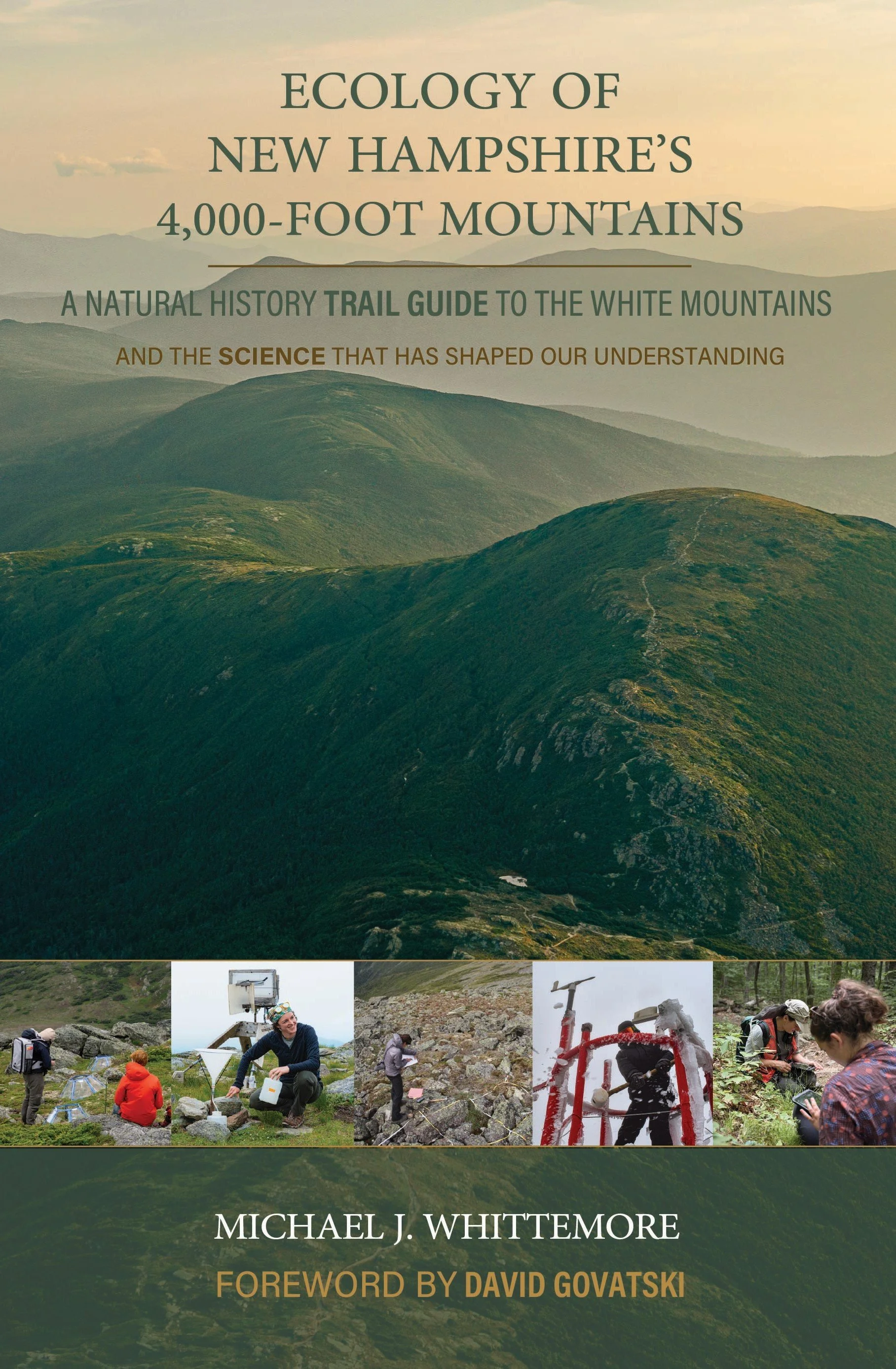
Nearly 400 photographs from more than 200 photographers, naturalists, researchers, hikers, and citizen scientists bring the ecology of the White Mountains to life.
Their images document alpine plants, wildlife, forests, geology, research, landscapes, and trails across the region. Every photograph is individually credited in the book, reflecting the extraordinary community collaboration behind the project.
Foreword by David Govatski
The book features a foreword by David Govatski, longtime White Mountains conservationist, naturalist, educator, and retired U.S. Forest Service forester whose work has spanned forest ecology, conservation history, and public interpretation throughout northern New Hampshire.
About the Author
Michael J. Whittemore is an ecologist, botanist, conservation professional, and founder of Rewild Ecological. He has more than a decade of experience in ecological restoration, botanical surveys, land stewardship, and conservation science, with past positions at The Nature Conservancy, Woodwell Climate Research Center, Frenchman Bay Conservancy, and the Central Pine Barrens Commission.
He holds an M.S. in Environmental Studies from Ohio University, where his graduate research focused on mapping plant communities across a 2,000-acre old-growth forest. In 2026, he led a botanical inventory of The Bowl Research Natural Area in the White Mountain National Forest.
An avid hiker, Michael has completed New Hampshire’s 48 4,000-footers and the Northeast 111. His work combines field ecology, conservation, and a commitment to helping people better understand the landscapes they explore.